
Middletown Township Previous Residents Sources
For a Middletown Township address, use the record type that fits the time period and question. A deed chain tracks recorded interests. Address-first directories and census schedules provide dated household clues. Probate and newspapers can add family context. None of those layers supplies a continuous or complete roll of former occupants, so preserve the date and source with every finding.
| Source | Years it covers | Where held | What it shows |
|---|---|---|---|
| Recorder holdings | 1684-present | Recorder, LANDEX, or county research counter | Recorded deeds, mortgages, plans, and party-year indexes |
| Recorder historic index bands | 1684-1919 through 1999-present groups | Recorder index aids | The correct era-based path for a party search |
| Lower Bucks criss-cross directories | 1986-1995; 1996 missing | Library of Congress holdings guide | Printed address-first listed person or business |
| Lower Bucks city and telephone directories | 1970-1996 | Library of Congress holdings guide | Name-first directory snapshots |
| Historic Bucks directory leads | 1871, 1894, 1902, 1912, 1914 | Mercer, BCFL, catalogs, and onsite collections | Name, place, occupation, and post-office context |
| Federal census schedules | Released schedules through the 72-year rule | Federal archive and library genealogy access | Household snapshot on the census date, not title |
Start with assessment and deed records when the question is ownership. Start with a known historical year and a directory or census when the question is who lived here before. Then compare the two trails instead of treating either one as conclusive.
Middletown Township Address Records Start
Begin a Middletown Township house history in the free Bucks County Assessment iCare search, not in the deed index. The assessment record can supply the current assessed owner, map or parcel number, situs address, municipality, and sales or property categories. Retain the parcel number. It is the steady join key when a street name, postal label, or older legal description changes.
Next, use Bucks County Maps & Data to view the parcel context and confirm the municipality. A Langhorne or Levittown mailing label does not settle the government jurisdiction. The Township or county record custodian should be selected from the parcel municipality and the document type, not from a postal-city guess.
Keep the labels separate. A situs address identifies the physical parcel. A tax mailing address is correspondence information and does not prove that its recipient lived at the property.
For Middletown Township, the assessment card and map establish the starting point. They do not establish every earlier owner or household member.
Middletown Township Deed Record Chain
The Bucks County property-records route directs document research to the paid remote LANDEX system or the county research area. In the Recorder’s terminology, a seller or borrower is the Direct Party, and a buyer or lender is the Indirect Party. Use the assessed owner as an Indirect Party near the likely purchase date, then read the deed itself. The recital or “being” clause can name a predecessor or cite the older book, page, instrument, tract, or plan reference needed for the next search.
- Search the known physical address in Assessment and record parcel number, municipality, assessed owner, and sale clue.
- Map-check the Middletown Township parcel, then search that owner in LANDEX as an Indirect Party around the acquisition.
- Obtain and read the recorded deed through the paid image route or Recorder counter. Capture the legal description and every predecessor reference.
- Find the predecessor’s acquisition as an Indirect Party, or find the later seller as a Direct Party, depending on the transaction role.
- Repeat the process backward, keeping a dated list of the source, party role, book/page or instrument number, and parcel description.
- Grantor
- The party transferring an interest in a recorded deed. Bucks calls a seller or borrower the Direct Party in its indexing terminology.
- Grantee
- The party receiving an interest. In Bucks Recorder terminology, a buyer or lender is the Indirect Party.
- Chain of title
- The sequence of recorded transfers used to trace an interest backward through time.
- Legal description
- The deed or plan language identifying land by lot, tract, plan, dimensions, or other record reference. It can bridge an address that did not yet exist.
Middletown Township Recorder Records Bands
The Recorder holds records from 1684 to the present, but its older research aids are organized in bands: 1684-1919, 1920-1941, 1942-1951, 1952-1963, 1964-1971, 1972-1979, 1980-1988, 1989-1993, 1994-1998, and 1999-present. Earlier indexes are not simply a single alphabetical address list. A full party name and approximate year help identify the proper index path.
Since July 1, 2012, newly recorded documents use an instrument number. Older Middletown Township chains commonly point to book and page. LANDEX provides general, instrument-number, and book-and-page search modes, and its person search requires a first-name value. Common surnames may need a date range or first-name narrowing because the system limits name matches.
A selected remote image is a paid PDF. Certification comes from the Bucks County Recorder of Deeds, not the vendor. The county’s public research area is a distinct access route, and staff can explain access but do not perform title research for a visitor.
Note: A deed tells what the recorded document says about an interest in land, not necessarily who occupied the address on that date.
Middletown Township Previous Residents Directories
Past owners and earlier occupants are not the same thing. The Lower Bucks criss-cross directories from 1986 through 1995, with 1996 missing, are the best verified address-first household layer for this question. They can place the directory’s listed person or business at a published address. The 1970-1996 Lower Bucks city and telephone directories add a name-first layer. Both are snapshots, not proof of an uninterrupted stay or a complete household.
For earlier Middletown Township research, use periodic Bucks directory leads from 1871, 1894, 1902, 1912, and 1914. Search historic variants such as Woodbourne, Emilie, Oxford Valley, Attleboro, Langhorne, Penndel, Hulmeville, and Levittown. The collection details and entry-reading limits are available in the Middletown Township directory book.
The dated sequence is simple: property owner or deed party, then directory listing, then census household, followed by probate or newspaper context if needed. Each source has a different purpose. A directory can supply a listed address, while a census can reveal the household captured on its own date.
Middletown Township Household Records Pairing
Pairing sources keeps a Middletown Township trail from overstating what it knows. Choose a directory year close to the period in question. Copy the name spelling, printed locality, address, and occupation or relationship clue if present. Then check the closest released federal census schedule and ask whether the household, age pattern, or locality supports the same identity. A census is a household snapshot, while a deed chain remains an ownership record.
- Set an approximate year from the deed, directory, or family record.
- Search the period’s locality wording, not only the modern Township label.
- Log the directory entry exactly as printed and record its publication year.
- Compare the entry with the closest released census schedule, allowing for date differences.
- Use probate, an obituary, or a recorded transfer to test a move, death, inheritance, or name change.
- Criss-cross directory
- An address-first volume that may identify the person or business listed at a printed address on its publication date.
- Enumeration district
- The census area used to organize the population count. It helps locate a household within the census, but it is not a parcel number.
- Household snapshot
- A dated record of people counted or listed together, without proof that the group remained unchanged over time.
Middletown Township Previous Address Records
The Middletown Township history explains why an old address may have more than one place name. Attleboro became Langhorne in 1876. Langhorne, Langhorne Manor, Hulmeville, and Penndel later separated from historic Middletown Township. A household could therefore appear first under Middletown and later under a separate borough without a long-distance move.
Levittown adds another layer. Its postwar development was built in the late 1950s and completed in 1958, and alphabetized street sections persist. A Levittown postal label may cover more than one municipality. For this historical research, keep the historic locality, parcel municipality, legal description, and current address in separate note fields.
The Township history source provides the geographic context for these name changes.
The Middletown Township history image is a reminder to search the locality that the historical record actually used before linking it to a modern parcel.
Middletown Township Estate Records Endpoints
When a historical address trail reaches a death, inheritance, or marriage question, the Bucks Register Archive Research Center is a useful county source. Its material begins in 1684, with originals from 1684 through 1936 and complete microfilm available through county channels. It accepts in-person and mail research requests. Probate can identify heirs or an estate event, but it does not establish that every heir lived at the subject property.
The Mercer Museum Research Library adds county newspapers, maps, church records, photographs, and manuscripts. A newspaper or obituary can suggest kinship or a new locality; compare it with probate, a death record, or the next deed before treating the clue as settled. Pennsylvania public-era birth records open after 105 years and death records after 50 years under the Vital Statistics Law, while marriage records follow the issuing-county route and divorce decrees are court files.
The Register archival search route is shown here for a Middletown Township estate or marriage-history lead.
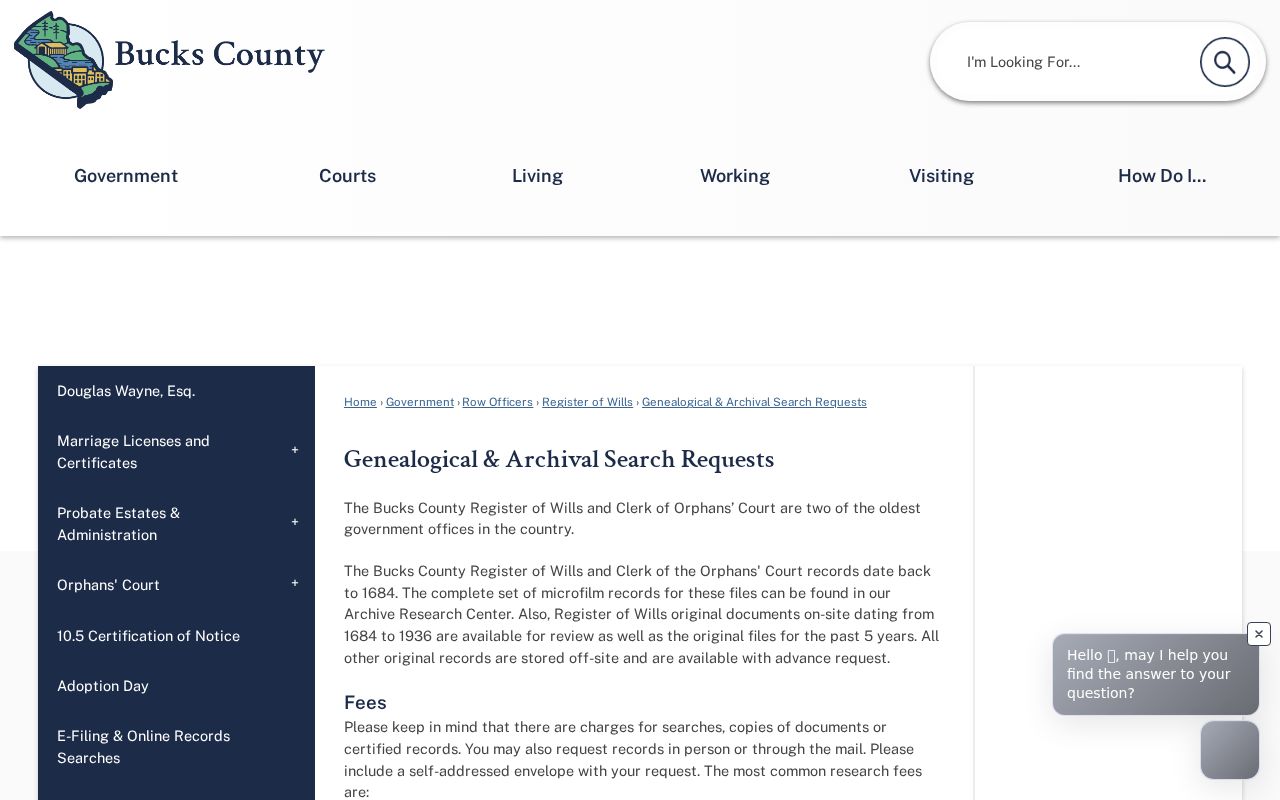
Use a Register or Mercer result to identify the next original source, then keep it distinct from the parcel ownership chain.
Middletown Township House History Records
Middletown Township house history has limits worth keeping in the notes. No verified street renumbering history or authoritative Sanborn-map year list was located in the research. Older deeds may use a tract, lot, adjoining owner, subdivision plan, or recital instead of a modern number. The Recorder’s recorded plans and the legal description can therefore be more reliable bridges than an address-only search.
Township permits can add a dated physical-work layer, but no public historic permit or code-case search was located. The Middletown Township Building & Zoning Department holds the relevant municipal file. A narrow request should identify the address, parcel where known, date range, and permit or record type rather than ask for a compiled people list.
Lawful personal use. Middletown Township previous-resident research is for family history, house history, heirs, and civic curiosity. Do not use record fragments to harass, stalk, or harm a living person, and leave any protected-address information alone.
Keep the final trail modest: recorded interest, listed address, household snapshot, and historical context. Each can be useful, but none justifies a claim about a person beyond the record’s date and purpose.